The element
What is tungsten?
Tungsten is element 74, a hard, steel-grey metal with the highest melting point of any metal on the periodic table. It is also one of the densest: 19.3 grams per cubic centimetre, almost exactly the density of gold.
- Symbol
- W
- Atomic number
- 74
- Atomic mass
- 183.84
- Density
- 19.3 g/cm³
- Melting point
- 3,422 °C (6,192 °F)
- Crystal structure
- Body-centred cubic
- Main ores
- Wolframite, scheelite
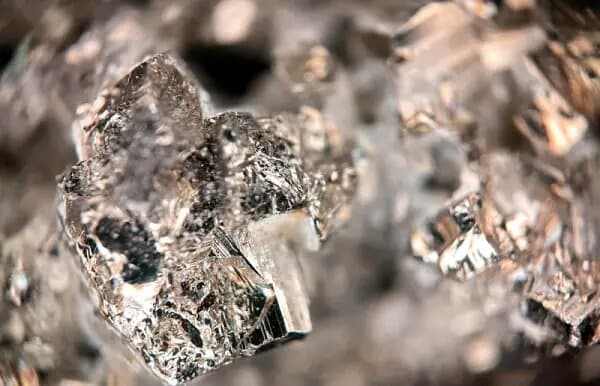
Why tungsten is so heavy
Density comes down to two things: how heavy each atom is, and how tightly the atoms pack. Tungsten scores high on both. Its atoms are massive, at 183.84 atomic mass units, and they sit in a compact body-centred cubic lattice.
The result is a metal about 70% denser than lead and roughly 2.5 times denser than steel. That is why a small tungsten cube feels wrong in the hand: your brain expects the weight of something that size to be far lower. See how much each cube size weighs.
Where the name comes from
The English name comes from the Swedish tung sten, meaning “heavy stone”. The chemical symbol W comes from its other name, wolfram, after the ore wolframite. In much of Europe the metal is still called wolfram today.
Carl Wilhelm Scheele identified a new acid in the mineral now called scheelite in 1781. Two years later the Spanish brothers Juan José and Fausto Elhuyar isolated the metal itself from wolframite.
Where tungsten is found
Tungsten never occurs as a pure metal in nature. It is mined from two main ores, wolframite and scheelite, then refined into powder and pressed and sintered into solid shapes. China produces the large majority of the world’s supply, with smaller output from countries including Vietnam, Russia and Bolivia.
What tungsten is used for
Most tungsten ends up as tungsten carbide, a compound hard enough to cut steel, used in machine tools, drill bits and mining equipment. The rest goes into high-speed steel, TIG welding electrodes, X-ray tube targets, radiation shielding and counterweights: anywhere a lot of mass or heat resistance has to fit in a small space. For a century it was also the glowing filament in incandescent light bulbs.
A solid cube is the purest expression of the property that makes it useful. Read more about what people do with a tungsten cube.
Common questions
- What is tungsten?
- Tungsten is a chemical element with the symbol W and atomic number 74. It is a hard, steel-grey transition metal with a density of 19.3 g/cm³ and the highest melting point of any metal, 3,422 °C.
- Why is tungsten's symbol W?
- W comes from wolfram, its older German name, taken from the ore wolframite. The English name tungsten comes from the Swedish tung sten, meaning heavy stone.
- What is tungsten used for?
- Most tungsten becomes tungsten carbide, used for cutting tools, drill bits and mining equipment. It is also used in high-speed steel, welding electrodes, X-ray tube targets, radiation shielding, and counterweights, anywhere a lot of mass has to fit in a small space.
- Is tungsten carbide the same as tungsten?
- No. Tungsten carbide is a compound of tungsten and carbon. It is harder than pure tungsten but noticeably less dense, at about 15.6 g/cm³ against 19.3. Most tungsten rings and tools are tungsten carbide, not pure tungsten.
Next
Compare tungsten with gold, lead and osmium on the metal density comparison, or hold some yourself: see every cube size.