Reference
How heavy is a tungsten cube?
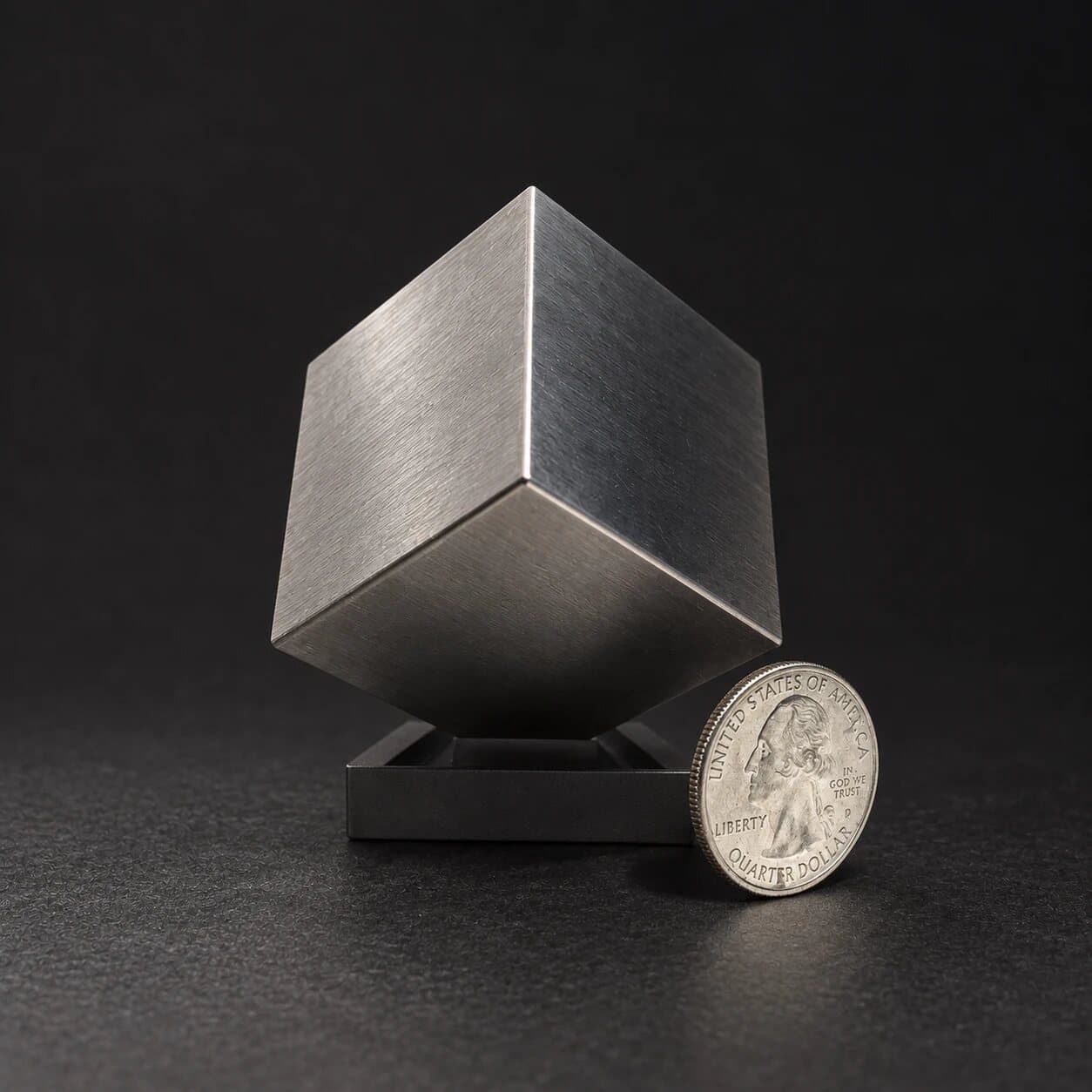
It depends entirely on the edge length, and the relationship is steeper than most people expect. A 1-inch tungsten cube weighs 316 grams. A 1.5-inch cube weighs 1.07 kilograms. A 2-inch cube weighs 2.53 kilograms.
All of it follows from one number: tungsten’s density of 19.3 grams per cubic centimetre, nearly twice that of lead and within a rounding error of gold.
Tungsten cube weight calculator
1.067 kg
2.35 lbs · 38.10 mm edge
Tungsten cube weight by size
| Edge (in) | Edge (mm) | Volume | Weight | Pounds |
|---|---|---|---|---|
| 0.5″ | 12.7 | 2.0 cm³ | 40 g | 0.09 |
| 0.75″ | 19.0 | 6.9 cm³ | 133 g | 0.29 |
| 1″ | 25.4 | 16.4 cm³ | 316 g | 0.70 |
| 1.25″ | 31.8 | 32.0 cm³ | 618 g | 1.36 |
| 1.5″ | 38.1 | 55.3 cm³ | 1.07 kg | 2.35 |
| 2″ | 50.8 | 131.1 cm³ | 2.53 kg | 5.58 |
| 2.5″ | 63.5 | 256.0 cm³ | 4.94 kg | 10.89 |
| 3″ | 76.2 | 442.5 cm³ | 8.54 kg | 18.83 |
| 4″ | 101.6 | 1048.8 cm³ | 20.24 kg | 44.62 |
| 6″ | 152.4 | 3539.6 cm³ | 68.31 kg | 150.61 |
The “1 kilogram” cube is not exactly a kilogram
Most sellers, including us, describe the 1.5-inch cube as a 1 kg cube. Run the arithmetic and it is 1.067 kg. A cube that weighs exactly 1.000 kg needs an edge of 37.27 mm, which is 1.467 inches.
The industry settled on 1.5 inches because it is a clean machining dimension and the extra 67 grams bothers nobody. We mention it because the people who buy these cubes are exactly the people who check.
Why size scales so violently
Volume scales with the cube of the edge length. Double the side and you get eight times the volume, and at constant density, eight times the mass. It is why a 1-inch cube is a curiosity you pass around and a 3-inch cube is 8.54 kilograms you set down carefully.
The formula is straightforward: mass in grams equals edge length in centimetres cubed, multiplied by 19.3.
Next
See how that density compares to gold, lead and osmium on the metal density comparison, or browse every cube size we offer.